The Threat to Rural Representation
Deschutes County is at a tipping point. Bend's population has exploded to over 107,000 residents — nearly half the county's ~214,000 people. Political activists based in Bend see an opportunity: if all five county commissioners are elected at-large, Bend's voting majority can control every single seat. The ranchers in La Pine, the farmers near Sisters, the families in Redmond — none of them would have a commissioner who answers to them.
That's not a hypothetical. It's exactly what the opposition wants. The Deschutes Defend Our Democracy Coalition, a Bend-based activist group, has openly declared their campaign to defeat the district map. Their deputy campaign manager Freddy Finney-Jordet announced after the February 4 vote: "Our work starts now. We are going to do everything we can to beat this map."
Think about that. A group based in Bend is organizing to ensure that Bend controls the entire county commission. They call it "defending democracy." We call it what it is: taking representation away from every community outside Bend.
Under at-large elections, Bend's 47% of registered voters could control 100% of commissioner seats. Under districts, Bend gets 2 of 5 seats — proportional to its population. The opposition isn't fighting for fairness. They're fighting for total control.
The Numbers Tell the Story
As of January 2025, Deschutes County has 162,696 registered voters. Non-affiliated voters are the single largest bloc at 33.6%, followed by Democrats (30.3%) and Republicans (27.8%). But the numbers are geographically lopsided:
- Inside Bend: ~28,000 Democrats vs. ~15,000 Republicans
- Outside Bend: ~29,000 Republicans vs. ~20,000 Democrats
At-large elections let Bend's concentrated voter advantage swamp everyone else. Geographic districts let each community choose its own representative. It's that simple.
How We Got Here
Two voter-approved measures set the stage:
- November 2022: Voters passed Measure 9-148 (61% support), making commissioner elections nonpartisan. Chief petitioners Susan Cobb and Mimi Alkire collected over 7,000 signatures.
- November 2024: Voters passed Measure 9-173 (~65% support), expanding the commission from 3 to 5 members. This was championed by John Heylin of Represent Deschutes, who argued a $728 million county budget shouldn't be overseen by just 3 people.
A 2006 precursor is worth noting: voters rejected a comprehensive reform package that would have added commissioners, made elections nonpartisan, and created districts — all in one measure. The piecemeal approach of 2022 and 2024 succeeded, but left the critical districting question unresolved.
Just eight days after the November 2024 election, commissioners began discussing districting. On March 31, 2025, they voted to start the process. The question was never whether to consider districts — it was how to draw them fairly.
The District Map (Map C)
A seven-member District Mapping Advisory Committee (DMAC) held 12 public meetings between August 27 and November 12, 2025 — including a community listening session — with sessions in Bend, Sisters, Redmond, and La Pine so every part of the county could participate. Every meeting was publicly noticed, livestreamed, and video recorded under Oregon's open meeting laws. The committee included community leaders from across the county: a La Pine Air Force veteran, a sixth-generation Sisters farmer, a Redmond business owner, the Bend mayor, a former League of Women Voters president, and others.
On February 4, 2026, Commissioners DeBone and Adair voted 2-1 to place Map C on the November 3, 2026 ballot.
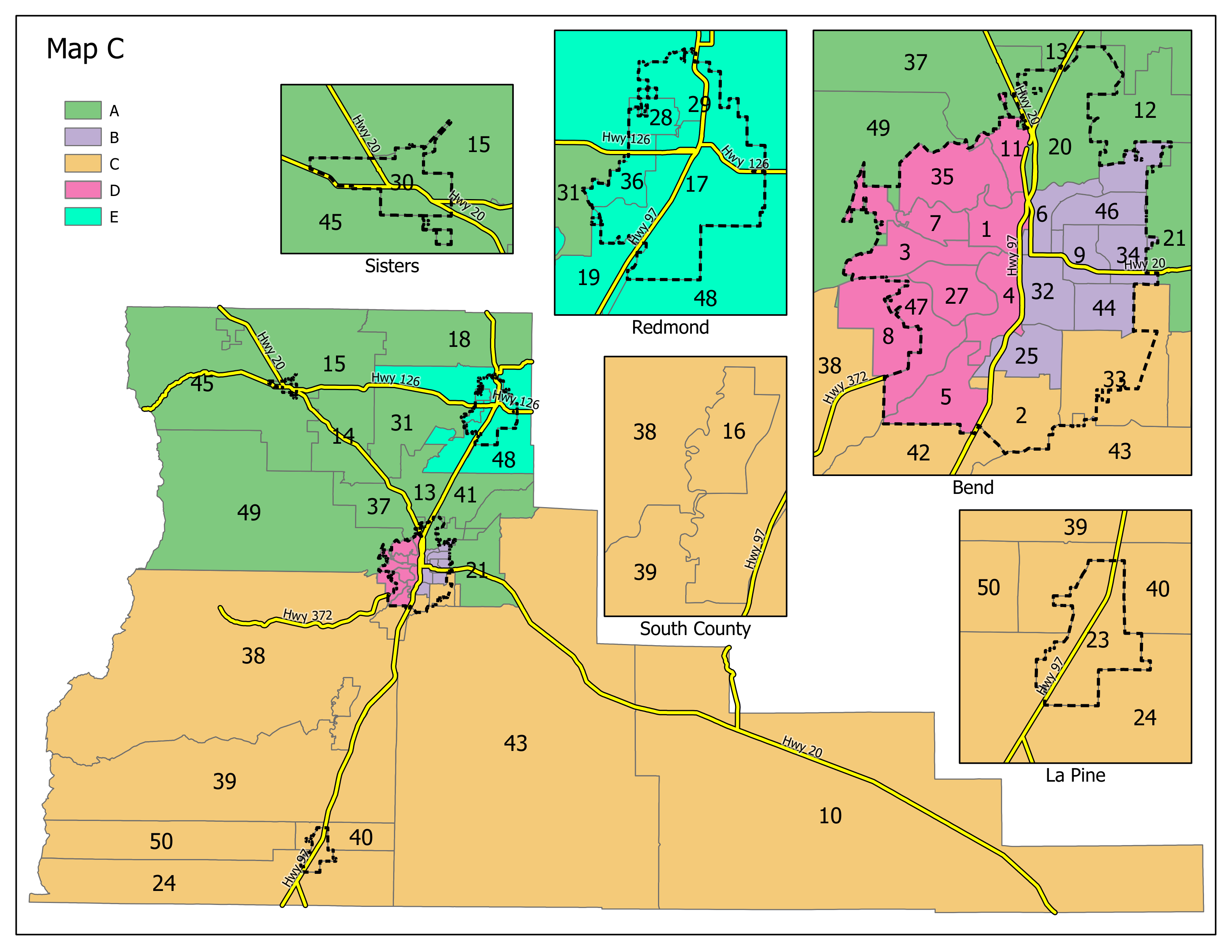
| District | Area | Community Needs |
|---|---|---|
| A | Sisters, north county, areas west of Bend | Agriculture, irrigation, rural infrastructure |
| B | West Bend | Urban services, housing, transit |
| C | East Bend | Urban services, growth management |
| D | Redmond, Terrebonne | Economic development, infrastructure, schools |
| E | La Pine, Sunriver, south county | Wildfire, water, emergency services, roads |
Each district elects one commissioner who must live in that district. Non-affiliated voters are the plurality in four of the five districts. View the official Map C with data graphs.
The official DMAC guidelines required that each district be contiguous, utilize existing precinct lines, not unreasonably divide communities of common interest, consider growth patterns, and explicitly prohibited drawing districts to favor any political party or dilute the voting strength of any ethnic or language minority group. The committee reviewed racial and ethnic demographic data to ensure compliance with these protections.
What the Opposition Is Really After
The Bend-based opposition — led by the Deschutes Defend Our Democracy Coalition, Commissioner Phil Chang, Bend Mayor Melanie Kebler, and the Source Weekly editorial board — frames the fight as being about "gerrymandering." But look at what they're actually advocating for: at-large elections where Bend controls every seat.
They claim the map is unfair because it gives rural areas representation. But consider the alternative they prefer: a system where a rancher in La Pine, a farmer near Sisters, or a small business owner in Redmond has zero guaranteed representation on the commission that controls a $728 million budget affecting their roads, their water, their emergency services, and their land.
The county shifted from Trump +3.3 in 2016 to Harris +10.4 in 2024 — the most Democratic presidential vote since Lyndon Johnson in 1964. That shift is almost entirely driven by Bend. Activists see a window to lock in control of county government through at-large elections before districts give rural communities a permanent voice. That's why they're fighting so hard to defeat this map.
The opposition's argument boils down to this: Bend should pick every commissioner, even the ones who make decisions about La Pine's roads, Redmond's infrastructure, and Sisters' water. Districts say: no, your community should pick your commissioner.
Districts vs. At-Large: The Real Comparison
Geographic Districts (Map C)
- Sisters, Redmond, La Pine each get a dedicated commissioner
- Your commissioner must live in your community
- Rural priorities can't be outvoted by Bend's majority
- Smaller campaigns = lower costs, more accessible to regular people
- Bend gets 2 of 5 seats — proportional to its population
- Five other Oregon counties already use this model
At-Large (What Opponents Want)
- Bend's 107,000 residents could control all 5 seats
- No commissioner has to live near voters they represent
- Rural issues easily overruled: water, wildfire, roads, land use
- County-wide campaigns favor Bend-based, well-funded candidates
- 47% of voters control 100% of seats
- Small communities have no guaranteed voice
Why Rural Representation Matters
The communities outside Bend aren't asking for special treatment. They're asking for any representation at all. Under at-large elections, a Bend-based majority could fill every commissioner seat with people who have never dealt with:
- Irrigation and water rights — the lifeblood of agricultural families who have farmed this land for generations
- Wildfire preparedness — south county and north county communities face existential fire risk every summer
- Rural road maintenance — miles of roads that Bend commuters never drive but rural families depend on daily
- Emergency services — EMS response times measured in miles, not blocks
- Land use decisions — development pressure from Bend spilling into rural areas without local input
- Economic diversity — supporting ranching, farming, timber, and small-town business alongside Bend's tourism and tech
The Legal Threats Are a Scare Tactic
Opponents are threatening lawsuits to intimidate voters. Former Oregon Deputy Attorney General Pete Shepherd has warned of "expensive and divisive litigation." They're hoping the threat alone will convince voters to reject the map.
Don't be fooled. Redistricting lawsuits are common across America — they're filed against virtually every new map everywhere. The committee followed its guidelines, held public meetings in four cities, and the map goes before voters for the final say. That's democracy working.
The real question is simple: should every community in Deschutes County have a voice, or should Bend pick every commissioner?
Vote YES on the district map — November 3, 2026. Don't let Bend activists silence your community. Let Deschutes vote!